Associated Lab Members

Dr. James Kelly received a Doctorate in Organic Chemistry from the University of Cambridge in 2011. His thesis work, supervised by Dr. Finian Leeper, focused on the development of conformationally restrained analogues of porphobilinogen as inhibitors of porphobilinogen deaminase. Upon completion of his doctoral work, Dr. Kelly spent one year as an Alfonso Casanava Research Fellow at the Universidad Complutense Madrid, supervised by Dr. Miguel Ángel Pozo, before transitioning to a two-year industrial research fellowship carried out at Instituto Tecnológico PET, Madrid. Dr. Kelly’s work in Spain focused on radiofluorination of small molecules for brain imaging and automation and validation of radiosynthesis procedures for small molecule PET probes. Dr. Kelly moved to the Molecular Imaging Innovations Institute (MI3) at Weill Cornell Medicine in 2014 as a postdoctoral fellow in the lab of Dr. John Babich, and was subsequently promoted to Instructor in 2017 and Assistant Professor of Radiopharmaceutical Sciences in Radiology in 2020. He is currently the Chief of Radiopharmaceutical Sciences at WCM. When not proselytizing about the virtues of radioactive materials in medicine, Dr. Kelly loves to run marathons and travel the world with his wife and daughter.
Areas of Specialization: Radiopharmaceutical development; PET imaging; radioligand therapy

Dr. Anja Wacker is a Postdoctoral Associate, who joined Dr. Kelly’s lab at the Department of Radiology on March 14, 2022. She has a strong background in chemistry and biochemistry from her M.Sc. and B.Sc. studies at the Technical University of Munich and holds a PhD in pharmacy from the Ruprecht-Karls-Universität in Heidelberg. Anja’s research interests focus on the design, synthesis and preclinical evaluation of innovative tracers for PET-imaging as well as the development of peptide-based compounds for targeted radiotherapy. She is inspired by the idea that advances in molecular imaging techniques can deepen our way of understanding biological functions, metabolic pathways and the evolution of pathological conditions, ultimately leading to improved personalized patient care.
Our multidisciplinary team aims to introduce novel chemistry and understanding of biochemical pathways active in disease to the radiopharmaceutical sciences. The broad goal of this effort is to improve the diagnostic and therapeutic toolboxes through increasing access to novel radiopharmaceuticals and identifying and validating new molecular targets. This research encompasses work with a broad list of radionuclides, including, carbon-11, fluorine-18, gallium-68, bromine-77, indium-111, iodine-124, iodine-125, cerium-134, lutetium-177, and actinium-225, as well as major human diseases such as heart failure, cancer, and neurodegenerative disease.
Current projects in the lab investigate mitochondrial metabolism in the heart as an imaging biomarker, the biological mediators of efficacy and resistance to targeted alpha therapy to identify new targets for combination therapy in cancer, and the formation and trafficking of toxic protein aggregates. Hypotheses that we are testing include:
Our long-term aim is to translate imaging and radioligand therapies to diagnosis and treatment of patients with heart failure, metastasized cancer, or neurological and neurodegenerative diseases.
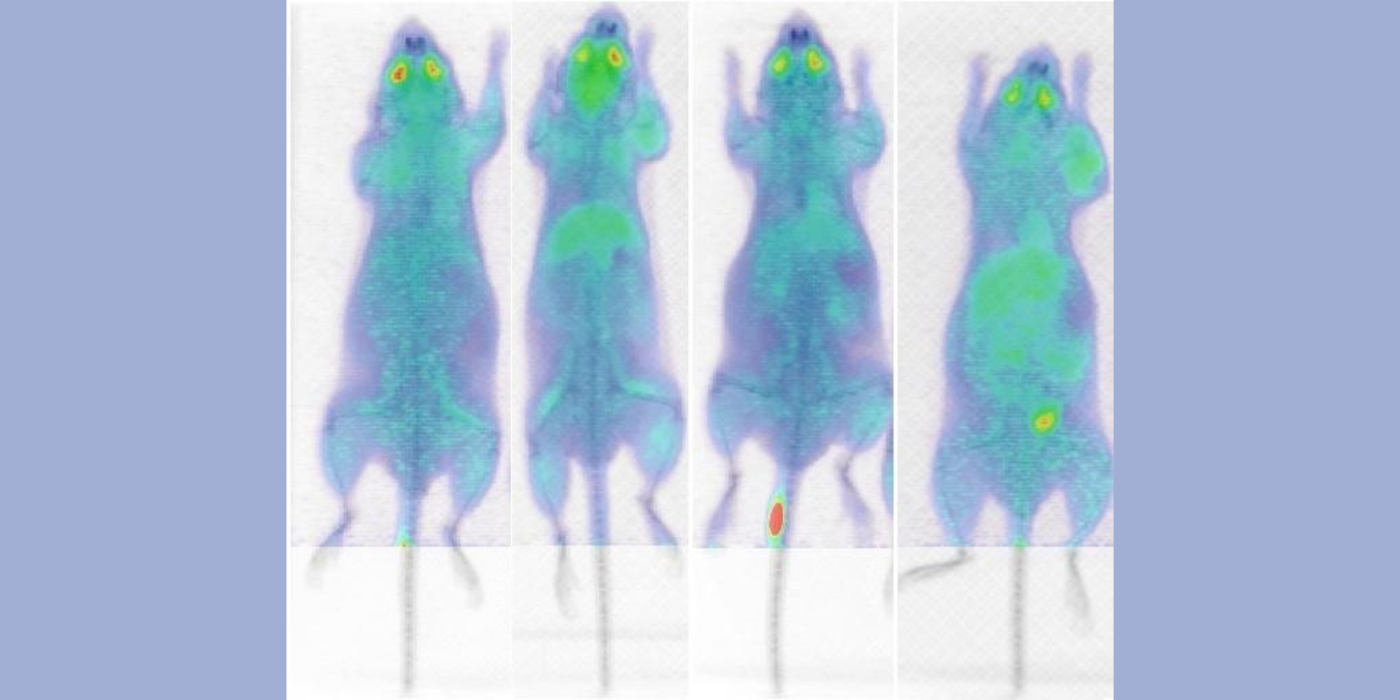
Our group is developing [18F]FPA as a PET imaging agent for cardiovascular disease, cancer, and neurodegenerative disease. This molecule, which is a short chain fatty acid analogue, is taken up by cells undergoing metabolic reprogramming. We have demonstrated significantly increased uptake in animal models of cardiotoxicity, heart failure, and glioblastoma with intact blood-brain barrier and are exploring its diagnostic utility in models of neurodegenerative disease.
Lactate is a preferred substrate for the heart and is synthetically accessible by a chemoenzymatic approach. In parallel to our studies with [3-11C]pyruvate, we are measuring the flux of radioactivity in tissue following administration of [3-11C]lactate, with a particular interest in cardiac and skeletal muscle.
In collaboration with industrial partners, we are also investigating the radiobiology of targeted alpha therapy (TAT) in cancer. Our TAT ligands target prostate specific membrane antigen (PSMA) and fibroblast activation protein (FAP).
Title: Imaging The Mouth-To-Brain Transport Of Aggregated Gingipains by PET
PIs: James Kelly, Chad Euler (CUNY-Hunter)
Dates: 07/2022-06/2024
Description: Our aim for this project is to develop methods for imaging protein aggregate trafficking by positron emission tomography (PET). We aim to demonstrate these methods by imaging the mouth-to-brain transport of gingipain aggregates. These aggregates may contribute to aspects of neurodegeneration observed in Alzheimer’s Disease.
Title: CSF Clearance in Sporadic Alzheimer's Disease
PI: Yi Li
Dates: 08/2018-04/2024
Description: We propose a longitudinal study of elderly normal control and MCI subjects to examine the clearance deficit in early stages of AD and association with brain Aβ burden and features of neurodegeneration (atrophy and cognitive function).
Title: Weill Cornell Medicine (WCM) SPORE in Prostate Cancer
PI: Massimo Loda
Dates: 02/01/18-01/31/25
Description: This application will further leverage our expertise across the spectrum of basic and translational research, computational genomics, clinical trials, and developmental therapeutics to benefit men across the landscape of lethal PCa, by focusing our scientific efforts on the study of therapeutic resistance.
2024
2023
2022
2021